
Maslow’s Hierarchy of Needs: 5 Levels Explained
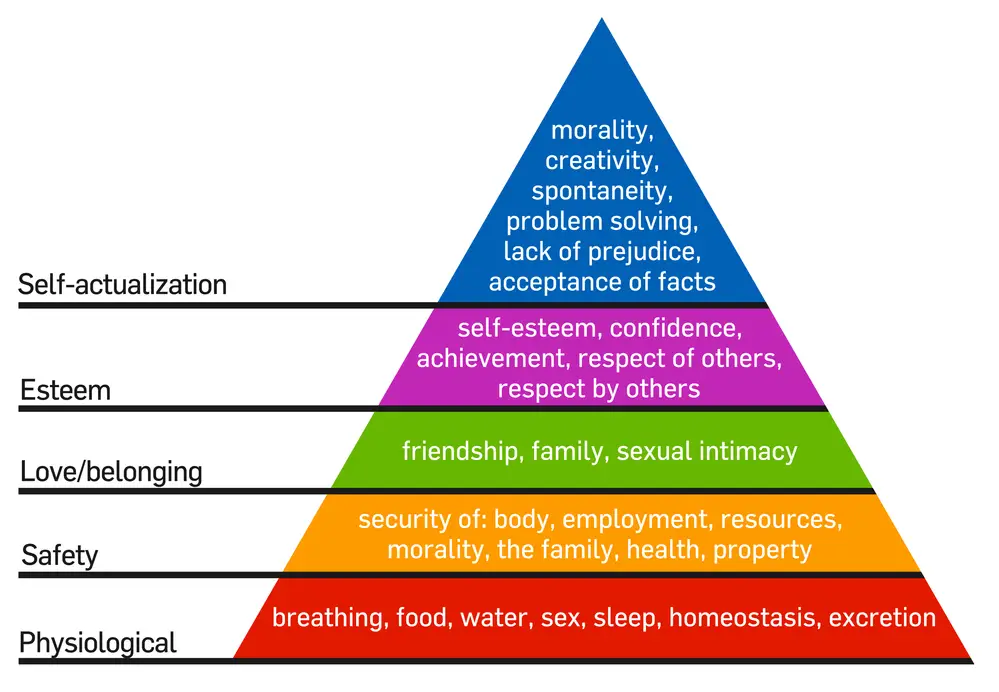
Maslow’s hierarchy of needs is a theory of human motivation developed by psychologist Abraham Maslow in 1943. It is commonly represented as a pyramid containing five levels: physiological needs, safety, love and belonging, esteem, and self-actualization.
The model suggests that basic needs often demand attention before people can focus fully on personal growth. However, people do not always progress through the levels in a fixed order, and several needs can influence behavior at the same time.
Below, we explain each of the five levels and how they may appear in everyday life.
What is Maslow’s hierarchy of needs?
Maslow’s hierarchy of needs is a psychological theory describing different types of human needs and how they can influence motivation. It is often illustrated as a pyramid, with foundational needs at the bottom and growth-oriented needs at the top.
The five levels, from the base of the traditional pyramid upward, are:
- Physiological needs
- Safety needs
- Love and belonging
- Esteem
- Self-actualization
The five levels of Abraham Maslow’s hierarchy (2) of needs are listed below from lowest to the highest:
Physiological Needs
Physiological needs are the basic requirements for human survival, including food, water, air, sleep and shelter. When these essentials are not adequately met, they can become a person’s strongest and most immediate priorities. Once they are reasonably satisfied, safety and stability may receive greater attention.
To explore how physical wellbeing connects with other areas of life, read about the 7 Dimensions of Wellness.
Safety Needs
Safety needs include physical protection, stable housing, financial security, health and a sense of predictability. These needs may become especially important during situations involving violence, illness, unemployment or major instability. Feeling reasonably safe can make it easier to focus on relationships, belonging and personal development.
Love/Belonging
Love and belonging needs involve feeling connected, accepted and valued by others. They can be met through friendships, family relationships, romantic partnerships and participation in social or community groups. Loneliness, rejection and isolation can make these needs especially noticeable and may affect motivation and emotional wellbeing.
Esteem Needs
Esteem needs involve feeling capable, respected and valued. Maslow described two related dimensions: receiving recognition and respect from others, and developing an internal sense of competence, independence and self-respect.
External recognition can include appreciation, status or acknowledgement for meaningful contributions. Internal esteem develops through mastery, responsibility and confidence in one’s abilities. Both can contribute to a healthier understanding of self-esteem.
When esteem needs are not adequately met, a person may experience self-doubt, inadequacy or become overly dependent on external approval. Learn more about the characteristics of low self-esteem and the signs of healthy self-esteem.
Self-Actualization
Self-actualization is the desire to develop one’s abilities and move toward fulfilling one’s potential. According to Maslow, its expression differs from person to person. It might involve creative work, meaningful relationships, education, service to others or pursuing an important personal goal.
Maslow originally proposed that people generally focus more fully on self-actualization after their basic needs are reasonably satisfied. However, the levels should not be understood as a rigid staircase. People may pursue growth and purpose while still experiencing unmet needs in other areas.
Psychologist Carl Rogers also explored personal growth and fulfillment. Learn more about Carl Rogers and self-actualization.
Self-Transcendence
Later in his work, Maslow discussed self-transcendence as a form of motivation extending beyond personal fulfillment. It involves connecting with a purpose greater than oneself through experiences such as service, spirituality, creativity, nature or dedication to a meaningful cause.
Self-transcendence is not always included in the familiar five-level pyramid, but it reflects Maslow’s later thinking about the development of human motivation.
Sources
- Maslow, A. H. (1943). A Theory of Human Motivation. Psychological Review, 50, 370–396.
- Koltko-Rivera, M. E. (2006). Rediscovering the Later Version of Maslow’s Hierarchy of Needs: Self-Transcendence and Opportunities for Theory, Research, and Unification. Review of General Psychology, 10(4), 302–317.